On this page
Vinted Profit vs Turnover: How to Work Out What You Actually Made
Worked example from the Resale IQ team.
Turnover is money in; profit is what is left after stock, fees, packaging and postage. A worked month, how to split a mixed lot, and what to record per item.

Turnover
The total money buyers paid you for the items you sold in a period, before you subtract any cost. Profit is turnover minus the cost of those items, fees, packaging and postage you paid.
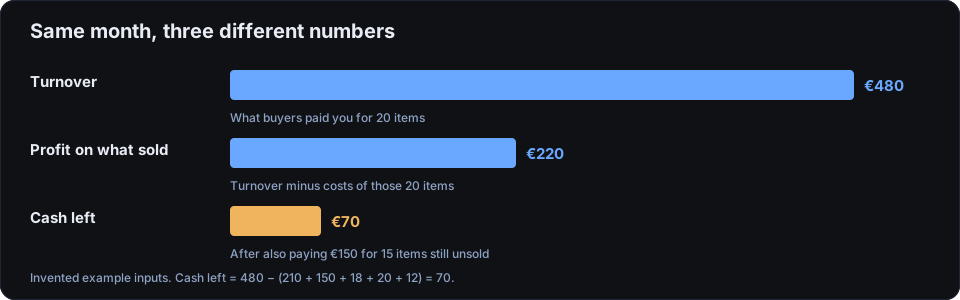
Turnover is all the money buyers paid you. Profit is what is left after you subtract what you paid for the items you sold, plus fees, packaging and any postage you covered. In our worked example, €480 of turnover is €220 of profit, and only €70 of cash once unsold stock is paid for.
What is the difference between turnover and profit on Vinted?
Turnover is what came in. Profit is what you kept. A post that says "I made €480 this month" is usually turnover, and the same month can be €220 of profit or less, depending on what the stock cost.
Four costs sit between the two: what you paid for the items that sold, any selling fees, packaging, and postage you paid yourself. Our fees guide covers what Vinted itself charges; read it for the platform side of the sum.
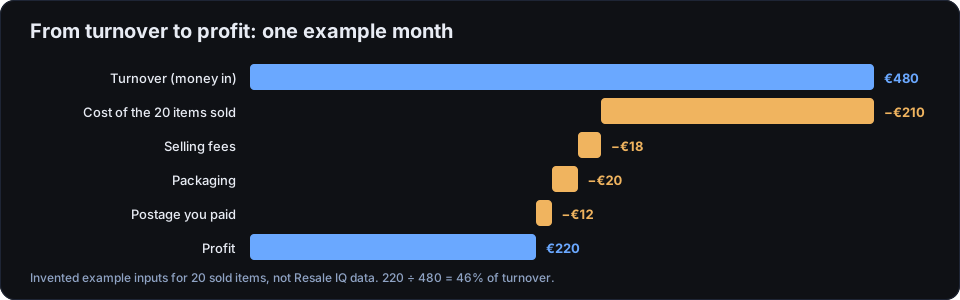
How do you work out profit for a month, step by step?
List the items that sold in the month. Add up the money you received for them: that is turnover. Add up what you paid for those same items. Subtract that, then fees, packaging and postage you covered.
Example with invented inputs: 20 items sold for €480. The 20 items cost €210, fees were €18, packaging €1 each (€20) and you paid €12 postage on three parcels. Profit is 480 − 210 − 18 − 20 − 12 = €220, which is 46% of turnover.
Count only the stock that sold. Items you bought and have not sold yet are not a cost of this month's sales; they are the next section.
Why can you be profitable and still have no cash?
Stock you have paid for but not sold is money out with nothing in yet. In the same example, say you also paid €150 for 15 items that are still listed. Profit on what sold is still €220, but your cash for the month is 480 − (210 + 150 + 18 + 20 + 12) = €70.
Both numbers matter. Profit tells you whether the items you sold earned their keep. Cash tells you whether you can afford the next batch. Tracking the share of purchases that never sell is the check most people skip.
How do you split the cost of a mixed lot?
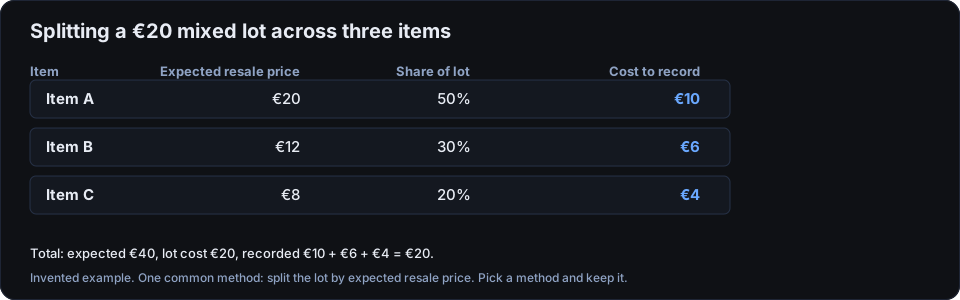
When you buy a bundle for one price, each item needs its own cost or the per-item profit is guesswork. One common method is to split the lot cost by each item's expected resale price. Pick one method and use it every time, so your numbers stay comparable.
Example with invented inputs: a €20 lot holds three items you expect to list at €20, €12 and €8. Together that is €40, so the items carry 50%, 30% and 20% of the cost: €10, €6 and €4. Sum check: 10 + 6 + 4 = €20.
To get the expected prices, check each item in the free item checker before you split. The lot calculator does the split for you.
Do you need a sales book or record at all?
That depends on your country and on whether the tax authority treats your selling as trading, and the answer is not the same everywhere. This article does not give a rule for it. For the UK, our tax guide states what GOV.UK says about the £1,000 allowance and the 30-sales reporting trigger, with links. Elsewhere, ask your tax office or a local adviser.
A separate point holds everywhere: a payout history shows money that came in. It does not show what you paid for the stock, what the packaging cost or which lot an item came from. Without those, you cannot work out profit later. The minimum per item is six fields: purchase price and date, sale price and date, fees and postage. Our record-keeping basics lists them.
What should you record for each item?
Record what you paid, the date you bought it, which lot it came from, the sale price, the date it sold, fees and postage you paid. Add packaging as a flat amount per parcel.
Two extras make the numbers useful. Record unsold items too, with their cost, so cash and profit stay separate. And note the hours you spent: €220 of profit for 22 hours is €10 an hour, and that figure changes which items are worth buying.
The margin calculator turns purchase price, sale price and costs into profit and margin before you buy.
A buyer disputing an item? Free dispute evidence kit →
Frequently asked questions
Is turnover the same as profit?
No. Turnover is all the money buyers paid you. Profit is turnover minus what the sold items cost you, fees, packaging and postage you paid.
How do I calculate profit per item?
Sale price minus purchase price, minus fees, minus packaging, minus postage you paid. For items bought in a lot, first split the lot cost across the items, for example by expected resale price.
Should unsold stock count in my profit?
Not in the profit on items that sold. Track it separately as stock you have paid for, because it reduces your cash until it sells.
Do I have to keep a sales record for Vinted?
It depends on your country and your tax status. This guide does not state a rule. For the UK, see our tax guide, which links to GOV.UK; elsewhere, ask your tax office or an adviser.
What do the examples show?
It explains how to calculate profit from your own figures. All amounts in the examples are invented.
Know before you buy.
Resale IQ turns 3M+ listing records into one answer: BUY, WATCH, or SKIP — with buy-below price and best sizes.
Check this item →Type a brand and model. Buy-below is on a plan.